GEMS vs MEPS: What's the Difference for LED Lighting in Australia?
Author:Admin Publish time: August 13, 2026 Origin: Site
If you are sourcing G4 or G9 LED lamps for Australia, understanding one simple difference can prevent a lot of confusion.
If you have recently discussed Australian LED compliance with a supplier, testing laboratory or certification consultant, you have probably heard two terms repeatedly:
GEMS and MEPS.
They are often used interchangeably — but they do not mean the same thing.
The simplest way to understand the difference is:
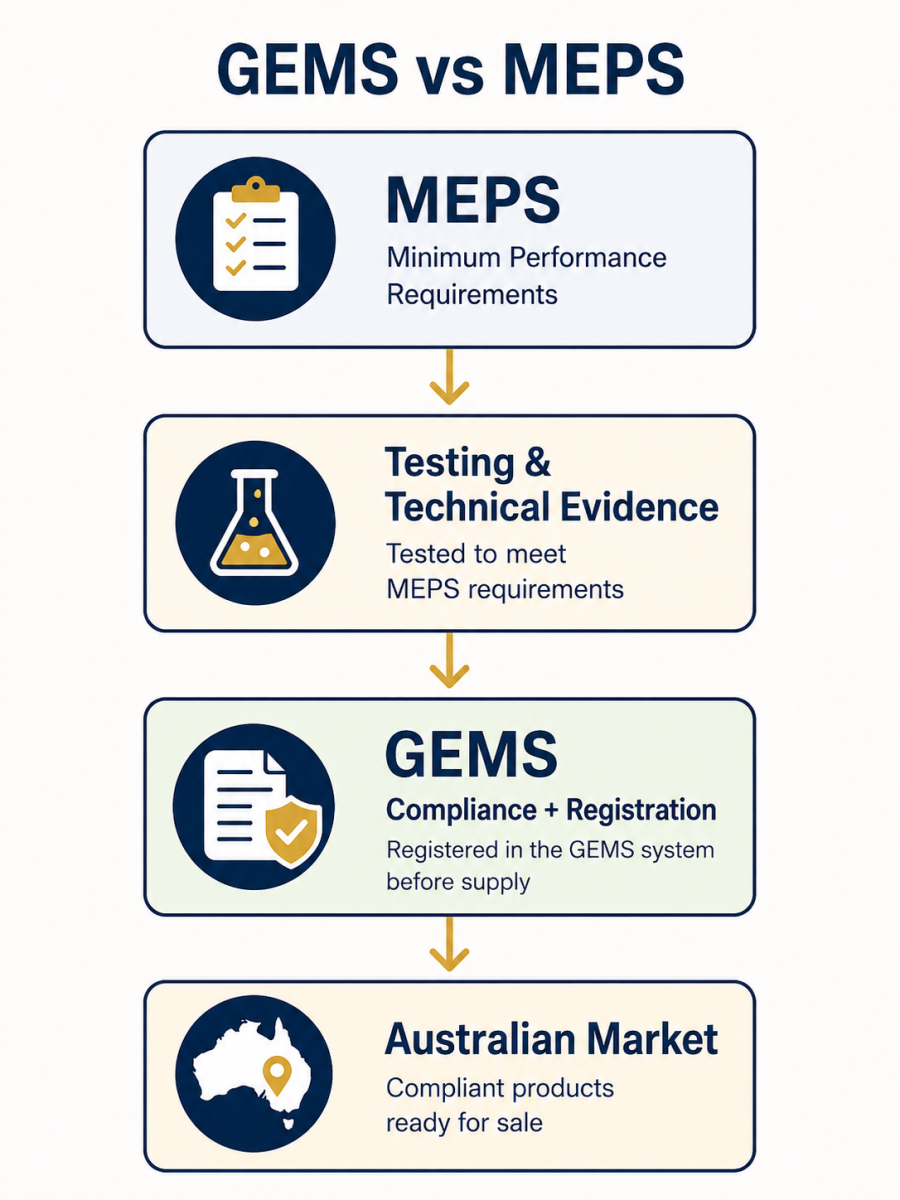
MEPS tells you the minimum performance your LED lamp must achieve.
GEMS is the regulatory framework under which applicable products must comply and be registered.
For lighting brands importing G4, G9 and other replacement LED lamps into Australia, understanding this distinction is important because passing a
test alone does not necessarily mean the product is ready to be legally supplied.
GEMS vs MEPS: The Simple Explanation
Here is the difference at a glance:
| MEPS | GEMS | |
|---|---|---|
| Full Name | Minimum Energy Performance Standards | Greenhouse and Energy Minimum Standards |
| What is it? | Minimum performance requirements | Australia's regulatory framework |
| For LED lamps | Defines minimum energy/performance requirements | Covers compliance and product registration |
| Is testing involved? | Yes | Test evidence supports registration |
| Is registration involved? | No — MEPS itself is not a registration | Yes, applicable models must be registered |
| Can an in-scope product be supplied without compliance? | No | No, unless an applicable grandfathering or exemption provision applies |
For in-scope LED lamps, the Greenhouse and Energy Minimum Standards (LED Lamps) Determination 2025 introduced MEPS, mandatory packaging information and other requirements under the GEMS framework.
The Determination came into effect on 3 March 2026. In-scope LED lamp models must now be registered in the Energy Rating Product Registration system before they can legally be sold or supplied in Australia, subject to applicable grandfathering provisions.
So when someone asks:
“Does this G9 have MEPS?”
the more useful question is:
“Does this G9 meet the applicable MEPS requirements, and is the model properly prepared for GEMS registration?”
Think of MEPS as the Standard — and GEMS as the System
For a lighting buyer, this is an easier way to remember it.
MEPS = Performance
MEPS establishes minimum energy-performance requirements that regulated products must meet.
For LED lamps, the current requirements include minimum luminous efficacy, with applicable adjustments depending on characteristics such as CRI, directional/non-directional design and certain other lamp features. The Determination also includes other quality and performance requirements.
GEMS = Compliance Framework
GEMS is the broader Australian regulatory system.
It covers how regulated products are:
tested → documented → registered → supplied to market
For in-scope LED lamps, meeting MEPS is therefore part of GEMS compliance, rather than a separate certification system.
Does a G9 LED Need GEMS Registration in Australia?
Potentially yes — if the exact G9 LED model falls within the scope of the LED Lamps Determination 2025.
The lamp base alone does not determine compliance status.
This matters because the term G9 LED can describe many technically different products:
- mains-voltage G9 lamps
- different wattages
- CRI80 / CRI90 / CRI95 versions
- 2700K / 3000K versions
- dimmable G9 lamps
- Dim-to-Warm G9 lamps
- different driver configurations
The correct approach is therefore:
Check the exact product configuration against the applicable scope — not simply the G9 base.
The same principle applies when evaluating G4 LED lamps for Australia.
What Does MEPS Mean for an LED Lamp?
One common misunderstanding is that MEPS is simply an efficiency number.
For LED lamps, the requirements go further.
The current LED Lamps Determination addresses areas including:
- minimum luminous efficacy
- CRI
- displacement factor
- lumen maintenance
- survival factor
- colour consistency
- flicker and stroboscopic effect where applicable
- UV and blue-light hazard requirements
- mandatory product and packaging information
Testing is based on AS/NZS 5341 and/or other equivalent tests specified in the Determination, depending on the requirement.
For a lighting brand, however, the practical principle is simple:
The performance you declare for your G4 or G9 should be supported by the product that was actually tested.
That is why compliance should be considered before the final product specification is changed or mass production begins.
FRI Has Already Completed MEPS-Related Testing
For Australian miniature LED projects, FRI is not starting from zero.
We have already completed MEPS-related testing for applicable LED lamp models and have supporting test reports available.
Our practical experience includes:
- test preparation
- LED lamp performance data
- model identification
- technical documentation
- coordinating tested specifications with production
For a lighting brand developing a G4 or G9 LED range for Australia, this may provide an opportunity to begin from an existing tested platform rather than starting the technical preparation completely from zero.
Whether an existing platform can support a new project still depends on the exact model and specification.
.jpg.png)
Caption:
Real testing. Real documentation. A better starting point for Australian LED projects.
Why Passing MEPS Is Not the End of the Process
Imagine a G9 sample is tested.
Then, before production:
lumen output is increased → wattage changes → driver is modified
The housing may remain identical.
But the technical product has changed.
This is why a test report should never be treated simply as a document that sits in a folder.
For in-scope LED lamps, the GEMS Regulator requires the corresponding technical information and documentation for registration. Test reports must exist for the models as required under the registration framework and be available when requested.
The relationship that matters is:
Tested Product = Documented Product = Registered Product = Production Product
This is particularly important for miniature G4 and G9 ranges, where several lamps may look almost identical while using different LEDs, drivers or electrical configurations.
Can Several G4 or G9 Models Be Registered Together?
Potentially.
The GEMS system allows an individual model or a standard family of up to 100 like models to be registered, provided the applicable family requirements are met. A special-purpose family can contain up to 10 models under the relevant rules.
This can be particularly relevant for a G9 range containing variations such as:
2700K / 3000K / CRI90 / CRI95 / different lumen outputs.
But similar appearance does not automatically mean the models qualify as one family.
That is why the best time to think about the product family is before testing, not after every SKU has already been developed independently.
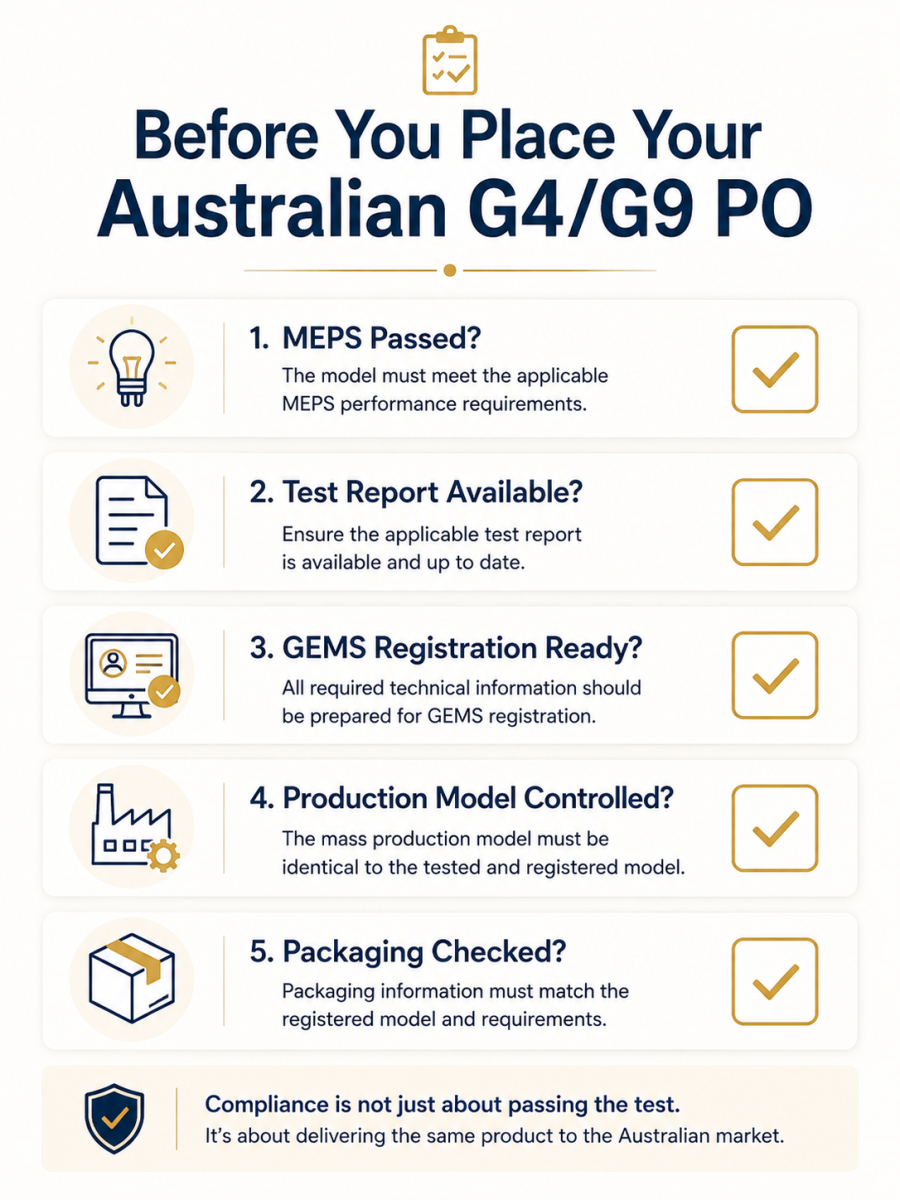
Before You Place Your Australian G4/G9 PO
Instead of asking your supplier only:
“Do you have MEPS?”
ask these seven questions:
Australian G4/G9 Buyer Checklist
✓ Is the exact model within the GEMS LED lamp scope?
✓ Has the final specification been confirmed?
✓ Does the model meet the applicable MEPS requirements?
✓ Is supporting test evidence available?
✓ Does the test report match the product being ordered?
✓ Is the required GEMS registration being handled?
✓ Does the packaging match the registered and tested specification?
MEPS tells you whether the product meets the required performance level. GEMS determines how that compliant product enters the regulated Australian market.
FAQ
Is GEMS the same as MEPS?
No. MEPS refers to minimum energy-performance requirements, while GEMS is the Australian regulatory framework covering applicable product requirements and registration. For in-scope LED lamps, meeting MEPS is part of GEMS compliance.
Is MEPS a certificate?
Not in the way buyers sometimes use the term. MEPS describes minimum performance requirements. Compliance is demonstrated through the applicable testing/documentation and the GEMS regulatory process.
Do LED lamps need GEMS registration in Australia?
In-scope LED lamps covered by the LED Lamps Determination 2025 must be registered to be legally supplied in Australia, subject to applicable grandfathering or exemption provisions.
Does a G9 LED need GEMS registration?
It depends on whether the exact G9 model falls within the Determination's scope. The base type alone does not determine regulatory status.
Has FRI completed MEPS testing?
Yes. FRI has completed MEPS-related testing for applicable LED lamp models and has supporting test reports available. The exact specification should still be checked model by model.
Can multiple G9 models use one GEMS family registration?
Potentially. Standard families can include up to 100 like models when the applicable family requirements are satisfied.
Not Sure Whether Your G4/G9 Is Ready for Australia?
If you already have a:
G4/G9 specification, model list, existing test report or packaging artwork, send it to us before mass production.
Because FRI already has experience with MEPS-related testing and Australian miniature LED projects, we can help identify whether your target product may build from an existing tested platform and what product-side information still needs to be prepared.
Send Us Your G4/G9 Specification →
MEPS is the performance requirement.
GEMS is the compliance framework.
The product you actually receive must remain aligned with both.