
Why Some G9 LEDs Flicker When Dimmed (And How to Fix It)
Author:Admin Publish time: August 5, 2026 Origin: Site
A Beautiful Lighting Design Can Fail Because of Something Invisible
A luxury chandelier can have the perfect shape.
The glass can be carefully selected.
The finish can be beautifully crafted.
The installation can look exactly like the designer imagined.
Until the lights are dimmed.
Then suddenly:
The lamp starts flickering.
The brightness jumps.
Some lamps stay on while others turn off.
The atmosphere disappears.
This is one of the most frustrating problems in decorative lighting.
Because from the outside, everything looks correct.
The problem is hidden inside the relationship between:
- LED lamp
- Driver electronics
- Dimmer
- Electrical system
Many people assume that replacing a halogen G9 with an LED is simply a matter of matching voltage and wattage.
In reality, dimming performance is one of the biggest challenges when designing reliable miniature LED solutions.
Why Do G9 LEDs Flicker When Dimmed?
1. The LED Driver and Dimmer Are Not Communicating Correctly
The most common reason for flickering is compatibility.
Traditional halogen lamps are simple resistive loads.
They naturally work with many traditional dimmers.
LED lamps are completely different.
Inside a G9 LED is an electronic driver that needs to convert electrical input into stable current for the LED chips.
When the dimmer reduces power, the driver must correctly interpret the signal.
If the two systems are not compatible, several problems can happen:
- Flickering
- Buzzing noise
- Limited dimming range
- Sudden shut-off
- Uneven brightness between lamps
The issue is not necessarily that the LED is poor.
The system simply does not work well together.
2. Why Miniature G9 LEDs Are More Difficult Than Larger LEDs
Many people think a smaller LED lamp should be easier to design.
The opposite is often true.
A G9 LED has very limited internal space.
Engineers need to fit:
- LED chips
- Driver electronics
- Thermal management
- Protection components
into a very small package.
At the same time, the lamp must provide:
- Smooth dimming
- Stable colour
- Low flicker
- Long lifetime
This creates a significant engineering challenge.
A large LED lamp has more room for electronics.
A miniature G9 has almost no margin for error.
3. Low-Level Dimming Is the Real Challenge
Many LED lamps perform well at 100% brightness.
The real test begins below 30%.
This is where customers notice quality differences.
A premium decorative lighting application often operates during:
- Evening dining
- Hotel ambience lighting
- Residential relaxation
- Restaurant service hours
At these moments, the lighting is usually dimmed.
A poor G9 LED may:
- Flicker at low brightness
- Suddenly increase output
- Lose colour quality
- Turn off below a certain level
A high-quality solution should remain stable from full brightness down to very low levels.
Engineering Insight: Why Low-Dim Performance Matters
Many LED lamps perform well at full brightness.
However, decorative lighting is rarely used at 100%.
Restaurants, hotels and residential spaces usually operate between 10–40% dim levels, where flicker performance becomes much more noticeable.
At FRI, we evaluate flicker behaviour across the complete dimming curve, not only at maximum output.
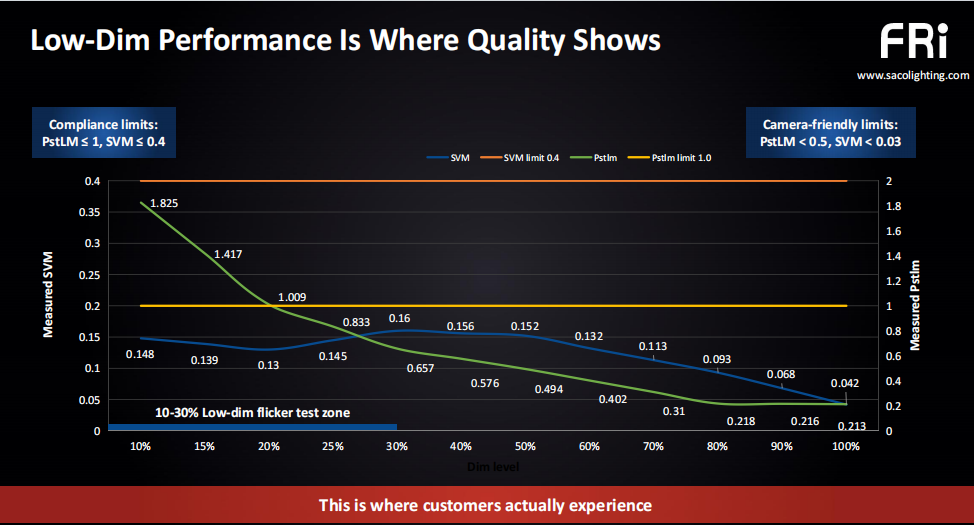
Real Engineering Evaluation
Why Flicker Matters More in Decorative Lighting
In functional lighting, flicker may simply be uncomfortable.
In decorative lighting, it can completely change the experience.
Imagine a restaurant with a beautiful chandelier above each table.
If the lamps are not stable:
The space feels cheaper.
Customers may not know why.
But they feel it.
Lighting is not only about visibility.
It is about emotion.
This is why premium lighting brands pay attention to:
- Flicker performance
- Visual comfort
- Dimming smoothness
- Colour stability
Common Mistakes When Choosing a Dimmable G9 LED
Mistake 1: Only Checking Wattage and Lumens
A 5W LED is not automatically equivalent to a 40W halogen.
Brightness is only one part of the experience.
The designer should also consider:
- Colour behaviour
- Dimming quality
- Compatibility
Mistake 2: Testing the Lamp Without the Real Dimmer
A common mistake is testing the LED alone.
However, the final application includes:
Lamp + Dimmer + Fixture.
The system should always be evaluated together.
Mistake 3: Ignoring Multiple Lamp Applications
One G9 lamp may look acceptable.
A chandelier with 12 G9 lamps will reveal every weakness.
Small differences become obvious.
This is why consistency testing is especially important for decorative lighting.
Engineering Insight: Flicker-Free Is a System Decision
At FRI, we believe flicker performance cannot be considered separately from the complete lighting system.
A reliable miniature LED solution requires:
- Stable driver design
- Controlled electronic components
- Compatibility testing
- Consistent production quality
Especially for G4 and G9 applications, where the available space is limited, engineering decisions made inside the lamp directly affect the final lighting experience.
Designer Checklist: Before Choosing a Dimmable G9 LED
✓ Has the lamp been tested with your dimmer?
✓ Does it dim smoothly below 20%?
✓ Is flicker performance measured?
✓ Does the colour remain stable during dimming?
✓ Will multiple lamps match in one fixture?
✓ Has it been tested inside a real luminaire?
The Future of Decorative Lighting Is About Experience, Not Just Efficiency
LED technology has successfully replaced halogen in terms of energy efficiency.
But premium decorative lighting requires more than efficiency.
It requires preserving the feeling people loved about traditional lighting.
Smooth dimming.
Warm atmosphere.
Visual comfort.
Consistency.
A successful G9 LED replacement should not remind people that they changed technology.
It should simply make the space feel better.
How FRI Helps Lighting Brands Solve G9 Dimming Challenges
FRI focuses on miniature LED solutions designed specifically for decorative lighting applications.
Our development approach combines:
- G4/G9 miniature engineering
- Dim-to-Warm technology
- Premium Color performance
- Low flicker design
- Lamp and dimmer compatibility testing
The goal is not simply to make a lamp that turns on.
The goal is to create a light source that performs reliably inside real decorative lighting projects.
Because the best lighting technology is often invisible.
People do not notice the LED.
They notice how the space feels.