
Why Your G9 LED Works on the Bench but Fails Inside the Fixture
Author:Admin Publish time: September 3, 2026 Origin: Site
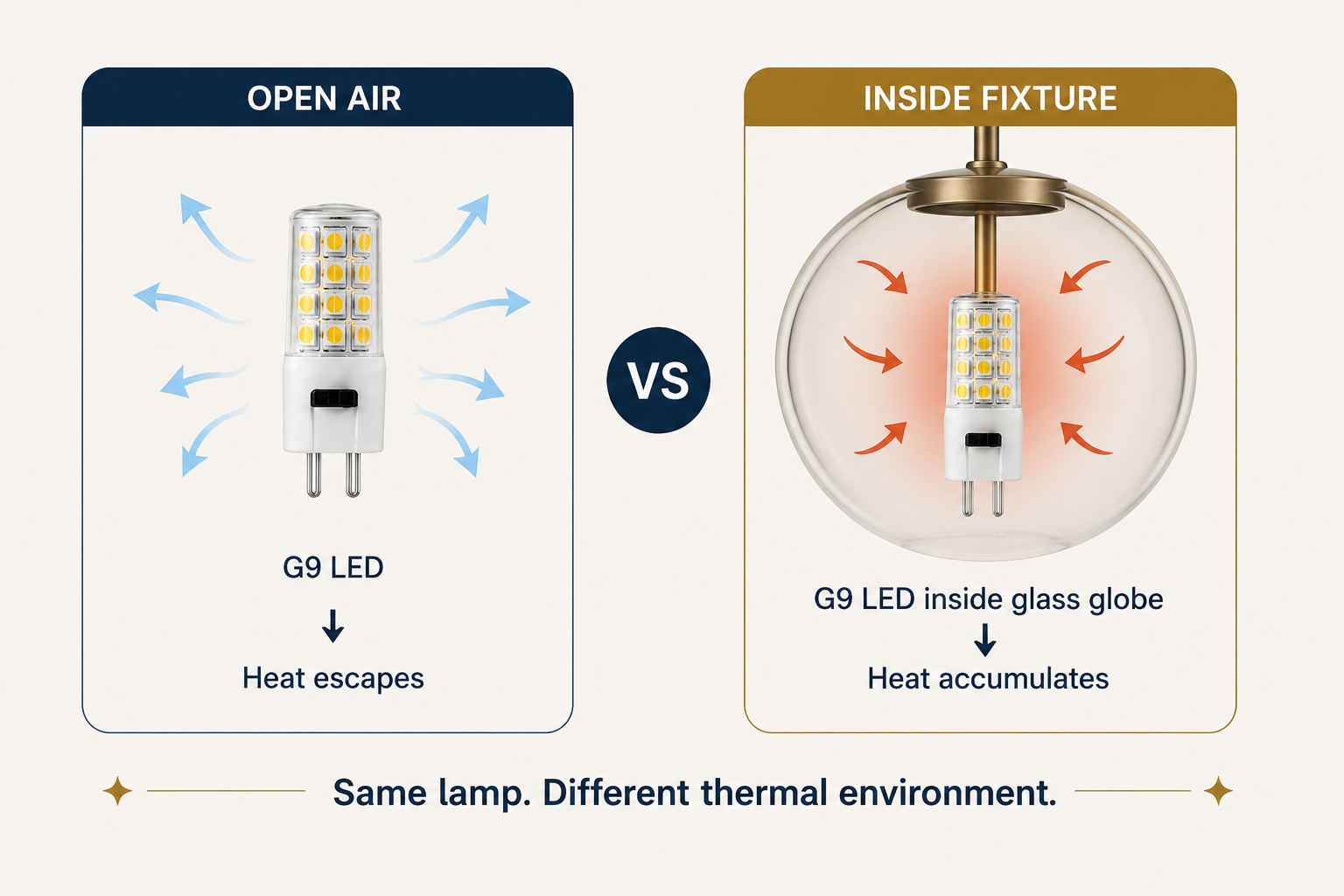
The lamp may be the same. Its operating environment is not.
A G9 LED sample arrives.
You test it on the bench:
Light output — good.
Color — good.
Dimming — smooth.
Everything seems ready.
But after the same lamp is installed inside a small glass globe or enclosed decorative fixture, the result may change.
The lamp runs hotter. Light output may decline faster. Dimming can become less stable, and long-term reliability may suffer.
So what changed?
Often, not the lamp.
The operating environment around it changed.
For miniature G4 and G9 LEDs, this can make a significant difference.
Why Miniature G9 LEDs Are More Challenging
A miniature G9 has very little internal space.
Yet inside that small body, engineers still need to accommodate:
LEDs · Driver Electronics · PCB · Insulation · Thermal Management
At the same time, customers want:
smaller size + more lumens + better dimming + longer lifetime
These requirements compete with each other.
Increasing power to achieve more lumens can create additional thermal stress, particularly when the lamp operates inside a compact fixture.
That is why the right question is not:
“What is the maximum lumen output of this G9?”
It is:
“What output can this G9 reliably deliver inside my fixture?”
Maximum Lumens Are Not Always the Best Choice
Imagine two G9 options for the same small glass globe:
4W / 450 lm
vs.
5W / 550 lm
The 550-lumen version looks better on a specification sheet.
But if the fixture is small and enclosed, the higher-output lamp may create a more demanding thermal condition.
In some applications, a slightly lower output with greater thermal margin can be the better engineering decision.
Maximum output is not always optimum output.
For decorative lighting, long-term reliability matters more than winning a lumen comparison on paper.
Heat Can Affect More Than Lifetime
Excessive operating temperature can place stress on several parts of a miniature LED lamp:
LEDs
Long-term lumen and color stability.
Driver Electronics
Electronic components may age faster at elevated temperatures.
Materials
Housing, insulation and other materials experience greater thermal stress.
Dimming
The internal electronics responsible for dimming operate in the same thermal environment.
This is why thermal management should be evaluated at the finished-lamp level, not only at LED-component level.
How Should a G9 Be Verified?
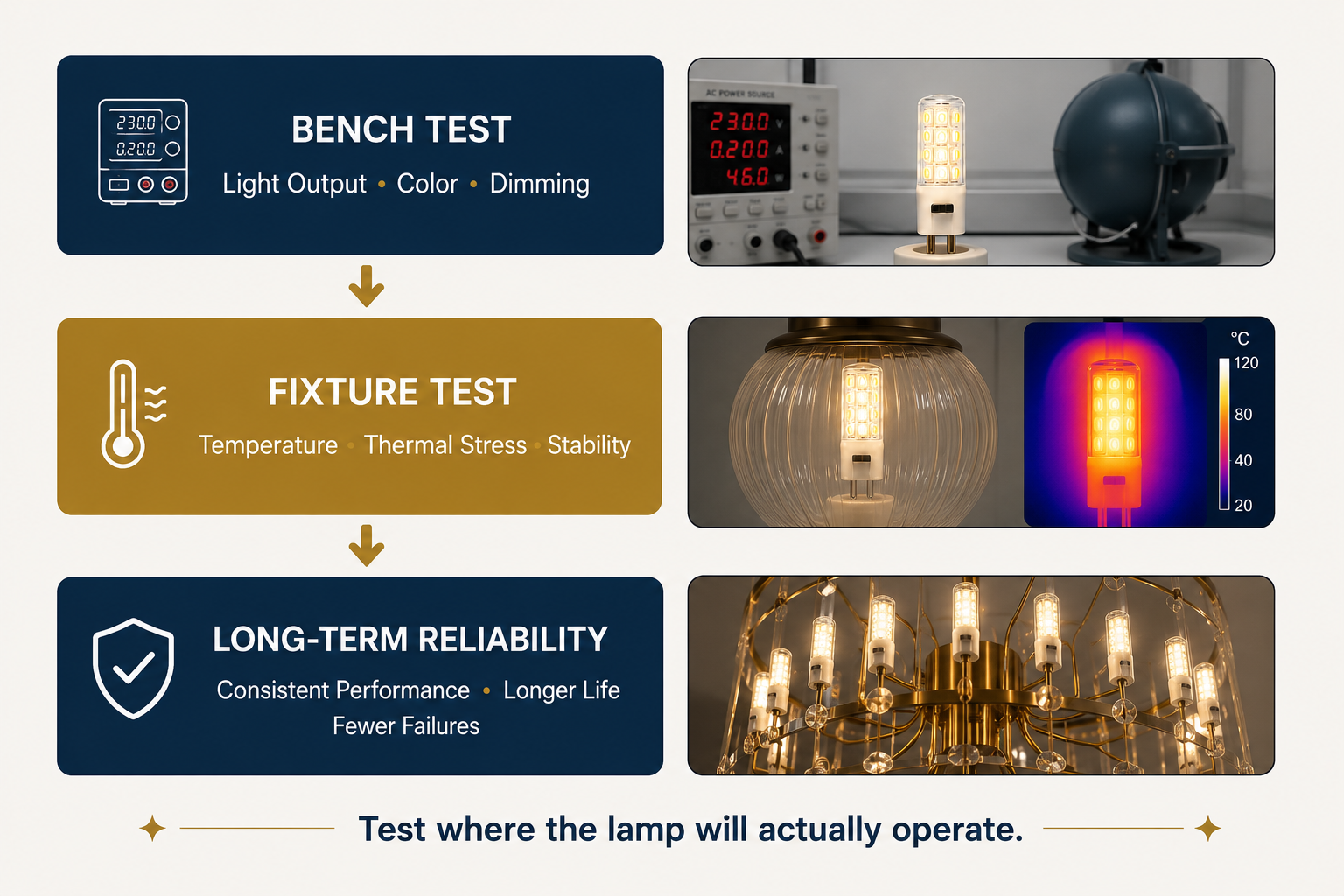
Bench testing is still important. But for demanding applications, it should be followed by application-relevant verification.
1. Understand the Fixture
Before finalising the G9 specification, ask:
Open or enclosed?
How much internal space?
How many lamps?
Is there ventilation?
2. Test the Lamp Inside the Fixture
For thermally demanding designs, test the actual lamp inside the real or representative fixture.
This tells you much more than open-air temperature alone.
3. Run Elevated-Temperature Aging
Longer-term testing at elevated ambient temperature can expose weaknesses that a short room-temperature test may never reveal.
At FRI, 50°C aging evaluation is one method used to assess the thermal robustness of miniature LED products.
4. Test the Finished Lamp
Reliability is determined by the complete product:
LED + Driver + PCB + Housing + Assembly
not simply by the quality of the LED chip.
Tell Your Supplier About the Fixture — Not Just the Lamp
A typical enquiry might say:
G9 · 4.5W · 500 lm · CRI95 · 2700K · Dimmable
That's useful.
But one additional question can completely change the engineering decision:
Where will the lamp operate?
If the supplier knows the G9 will operate inside a small enclosed glass globe, they can evaluate power, lumen output and thermal margin differently.
For critical projects, send:
Fixture photo + dimensions + lamp quantity + target lumens + dimmer information
An actual fixture sample is even better when thermal conditions are particularly demanding.
How FRI Approaches G9 Reliability
For miniature G4/G9 development, FRI looks beyond whether a new lamp reaches its specification at room temperature.
Depending on the project, evaluation can include:
finished-lamp testing
burn-in
thermal evaluation
50°C aging
dimming verification
and testing under representative fixture conditions.
The objective is simple:
The production lamp should perform reliably where the customer actually uses it — not only on our test bench.
Before Approving a G9 for Your Fixture
Ask six questions:
SIZE — Does it fit?
OUTPUT — How many lumens are really needed?
FIXTURE — Open or enclosed?
THERMAL — What temperature will it experience?
DIMMING — Which dimmer will be used?
RELIABILITY — Has the finished lamp been validated?
Start with the application — not the maximum specification.