
Why Your G9 LED Works on the Bench but Fails Inside the Fixture
Author:Admin Publish time: September 20, 2026 Origin: Site
A G9 LED can perform perfectly in open air — and still struggle once installed inside a decorative fixture.
You test a new G9 LED lamp on the bench.
The lumen output looks good.
The color is correct.
Dimming is smooth.
The lamp runs for hours without any obvious problem.
Everything seems ready.
Then the same G9 is installed inside a small glass pendant or enclosed decorative fixture.
After operating for some time, the result can be very different:
- the lamp becomes much hotter
- lumen output may decrease
- color may shift
- dimming stability may change
- components may age faster
- long-term reliability can suffer
What changed?
Not necessarily the lamp.
The operating environment changed.
For miniature G4 and G9 LEDs, this difference can be critical because a very small lamp already has limited space to manage heat.
Open-Air Testing Is Not the Same as Fixture Testing
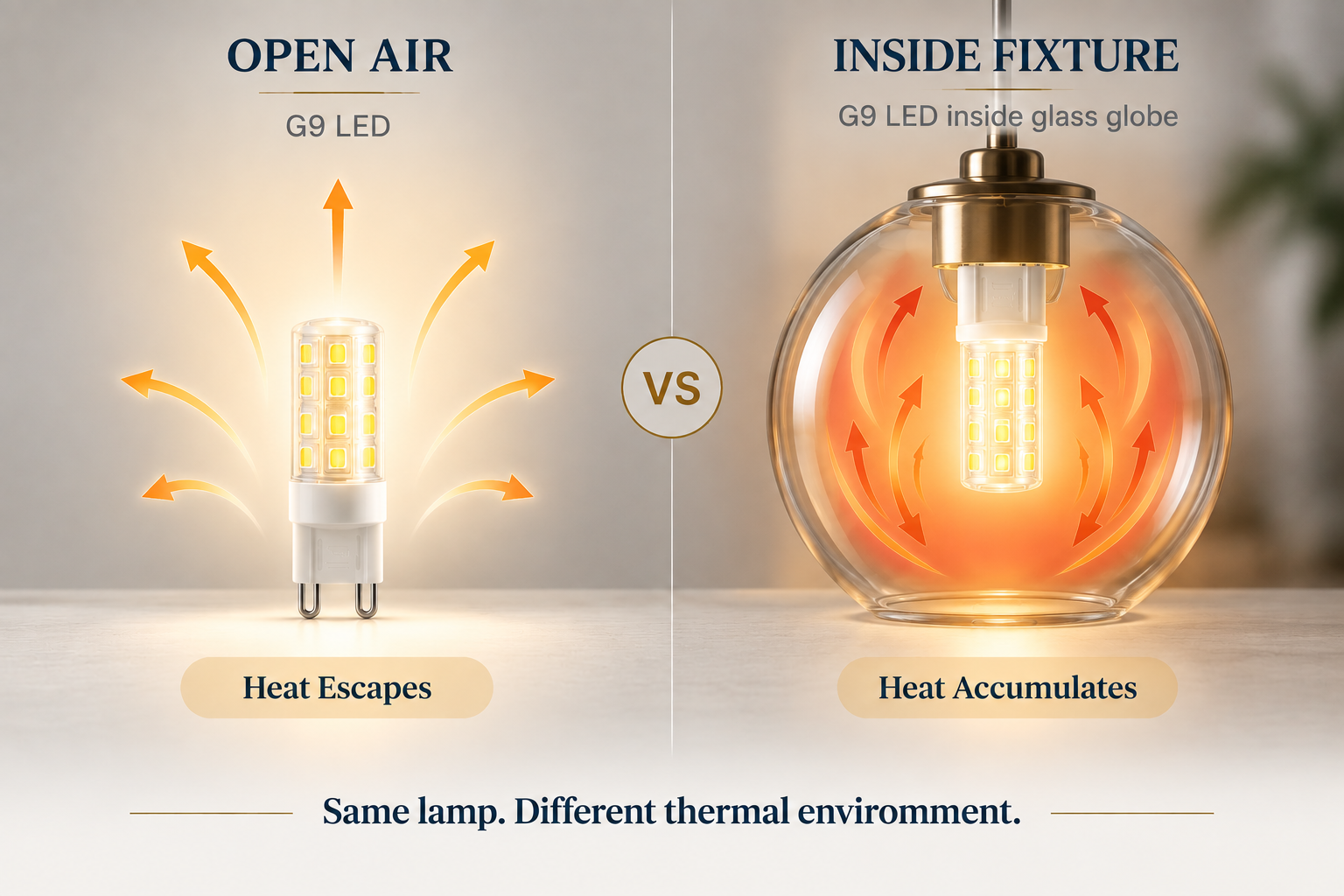
On a test bench, a G9 LED usually operates in relatively open air.
Heat generated by the LEDs, driver and electronic components can escape into the surrounding environment more easily.
Put that same lamp inside a decorative fixture and the thermal conditions change.
A glass globe, narrow shade or enclosed housing can restrict airflow and trap heat around the lamp.
So you may have:
Same G9 LED.
Same wattage.
Same room temperature.
But a very different internal operating temperature.
This is why a lamp that appears perfectly stable during a short bench test may behave differently after installation.
The fixture becomes part of the lamp's thermal environment.
Why Heat Matters So Much in a Miniature G9 LED
Every LED lamp generates heat.
The challenge with a miniature G9 LED is that there is very little physical space available to manage it.
Inside a small body, engineers need to accommodate:
LEDs + Driver Electronics + Components + Insulation + Thermal Path
while still keeping the lamp compact enough to fit into decorative fixtures.
As output increases, thermal pressure usually increases as well.
And when the fixture traps additional heat around the lamp, internal components may operate at temperatures significantly higher than they would in open air.
This can affect several areas.
LED Performance
Higher junction temperatures can reduce light output and accelerate lumen depreciation over time.
Electronic Components
Capacitors, ICs and other driver components are sensitive to operating temperature. Higher temperatures generally increase stress and can shorten component life.
Color Stability
Temperature can influence LED electrical and optical behavior, making thermal control relevant not only to lifetime but also to light quality.
Dimming
A dimmable G9 contains more demanding electronics than a simple non-dimmable lamp. Thermal conditions can therefore also influence stability under different dimming levels.
That is why maximizing wattage inside the smallest possible G9 is not always good engineering.
More output is useful only if the lamp can manage the heat reliably in the real application.
The Fixture Can Matter as Much as the Room Temperature
A common specification might state that the lamp operates at a particular ambient temperature.
But room temperature alone does not tell the whole story.
Imagine two rooms, both at 25°C.
In one room, the G9 operates openly inside a ventilated fixture.
In the other, the same G9 is surrounded by a small enclosed glass globe.
The room temperature is identical.
The lamp's actual thermal environment is not.
This is particularly relevant for decorative lighting because fixtures vary enormously:
Open chandelier
Small glass globe
Closed pendant
Narrow metal shade
Wall light with limited airflow
Each creates a different thermal condition around the lamp.
So when evaluating a G9 LED, asking only:
“What is the maximum ambient temperature?”
may not be enough.
A more useful question is:
“How will this lamp operate inside our actual fixture?”
Bench Testing Still Matters — But It Is Only the First Step
This does not mean laboratory or bench testing is unimportant.
It is essential.
Bench testing allows engineers to verify basic performance such as:
Power · Lumen · CCT · CRI · Dimming · Flicker
But these tests answer:
Does the lamp perform correctly?
Fixture testing answers a different question:
Can the lamp maintain that performance in the environment where the customer will actually use it?
The strongest validation combines both.
How FRI Approaches G9 Thermal Reliability
For miniature LEDs, we treat thermal performance as part of the product design rather than something checked only after development.
FRI uses thermal testing, production aging and long-term aging evaluation to understand how G4 and G9 lamps perform beyond the initial specification sheet.
We also support applications where lamps operate in fully enclosed fixtures and evaluate designs under elevated-temperature conditions.
The objective is not simply to make a G9 that produces the required lumens on the test bench.
It is to balance:
Size · Output · Dimming · Thermal Performance · Reliability
because all five interact inside a miniature lamp.